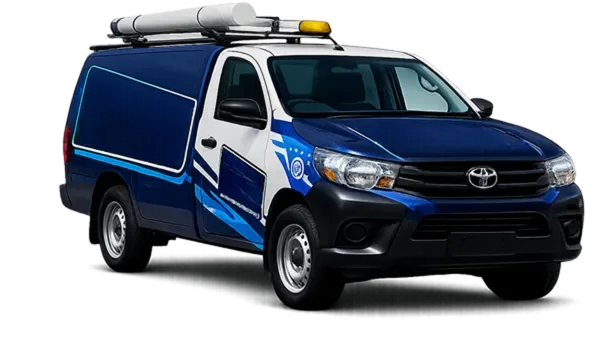
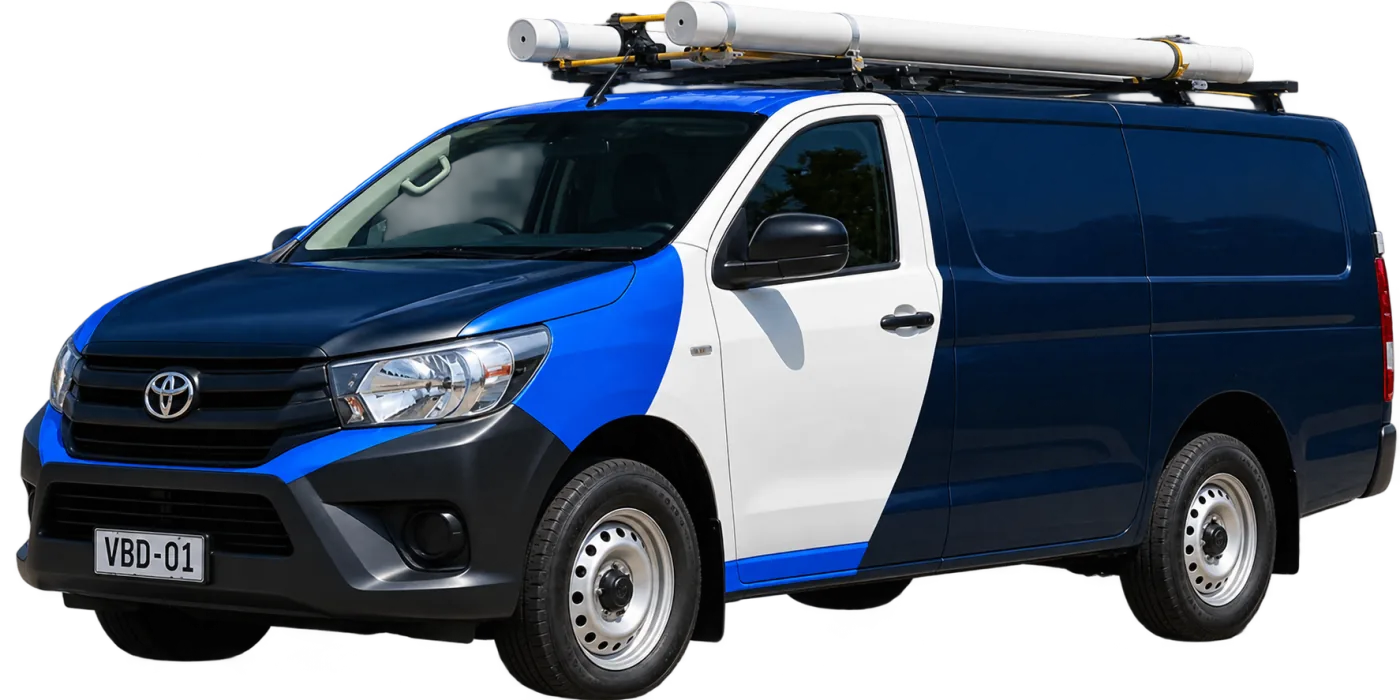
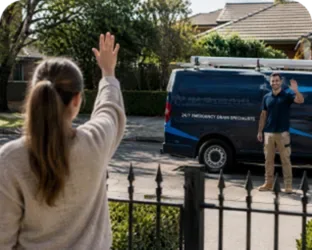
Cleared the same day where we can. We ask which side we can drive to before we leave, because on a lot of these blocks the front door does not face the road at all.
Online Now!·--:--
Five estates around Campbelltown were laid out on Radburn principles between 1972 and 1989: Airds, Macquarie Fields, Claymore, Minto and Ambarvale.
Radburn houses are built back to front deliberately. The front door opens onto a pedestrian walkway and a shared green, and the back door faces the street, with people and cars kept apart on purpose.
It makes for pleasant walking. It also means a plumber's van can only reach the fence side, and whether there is a usable gate in that fence decides how the whole job runs.
So we ask on the phone rather than finding out in your driveway. Thirty seconds of questions is why we turn up with the right gear on the right side instead of standing at a fence working out the geometry.


Tell us which door you take the bins out of. That answers it, and it is genuinely the most useful thing you can tell us before we set off.
On Radburn estates the front door faces a walkway and common open space, and the back door faces the road. Pedestrians and cars were separated on purpose.
Everything about getting equipment to a drain follows from that, so it is the first thing worth establishing rather than the last.
What a van can reach is the fence line. Whether there is a gate, and how wide it is, determines what we can bring to the drain.
Where there is no usable gate the gear comes in on foot along the walkway. That works perfectly well, it just takes longer, and it belongs in the price beforehand.
Pedestrian reserves and greens sit between the houses rather than behind them, so drainage can run out under land that is not part of any private yard.
A fault out there may not be yours to pay for. Establishing where your responsibility stops is worth doing before the repair is scoped, not after.
From 1995 the state began de-Radburnisation through the Neighbourhood Improvement Program, and Minto and Claymore saw heavy redevelopment.
Some streets were reversed to conventional frontages, others were left alone. Your neighbour's layout is frequently no guide at all to yours.
Which door faces the road, is there a gate, and roughly how far from the kerb is the fixture giving trouble.
Three questions, thirty seconds, and it decides what goes in the van. It is also what stops the price moving once we are on site.
Quoted at a fixed price before anyone starts. These are indicative 2026 ranges. Where access means carrying gear a distance, that is in the quoted figure rather than added later.
Through an existing access point, cleared and flow tested before we leave.
Footage handed over. What settles a drain that keeps coming back.
Roots and hardened build-up take longer than a soft blockage.
Where the line goes, marked at the surface, including where it leaves your boundary.
What we found and where your responsibility stops, in a form you can pass on.

Which door faces the road, is there a gate, and where is the trouble. That decides what goes in the van.

Through the existing access point, then run properly to confirm it is genuinely clear rather than just moving.

If it has happened before we film it, and we follow where the line goes, including past your boundary.

The footage plus a written note of what we found and whose section it sits in.
Tell us which side of the house we can drive to and a licensed plumber can be on the way. We would rather ask now than lose twenty minutes at your fence.
Call 1300 381 569
Because on a good number of Campbelltown streets the answer is the back one. Five estates here were built on Radburn principles between 1972 and 1989, which puts the front door onto a pedestrian walkway and the back door onto the street. A van can only get to the fence side. That one answer tells us where to park, whether there is a gate we can push a jetter through, and how much of the job is carrying gear. It is the difference between arriving ready and arriving to work it out.
We carry in, and we tell you that before we come rather than after. Where a rear gate is too narrow or there is not one at all, the equipment goes in on foot along the walkway from wherever the van could stop. A drain machine and a camera reel both travel fine that way, it simply takes longer, and that time belongs in the quoted price rather than appearing as a surprise. If access genuinely will not work for the gear a job needs, we say so on the phone.
Possibly not, and it is worth settling before anyone spends money. On a Radburn layout the pedestrian reserves and shared greens between houses are common open space rather than part of a private yard, so a fault out there can sit outside your boundary altogether. We locate where the line actually runs and where your responsibility stops, then put it in writing so you have something concrete to take to whoever owns the rest.
Because from 1995 the state began reversing these estates, and it did not do all of them. Some streets were given conventional frontages and new fencing under the renewal programs, Minto and Claymore were heavily redeveloped, and others were left as originally built. So two houses a hundred metres apart can face opposite ways. It is also why we ask about your place specifically instead of assuming from the street name.
No. They clear the bowl, which is all the label really promises, then fail to break down the way paper does. They snag on anything slightly rough inside the line and build from there. They are the single most common avoidable cause of the blockages we attend, and the fix costs a great deal more than the bin would have.
Rarely, and they can make the job worse. They sit on top of the blockage instead of passing through it, they generate heat, and in older pipework they attack the pipe about as enthusiastically as the obstruction. They also leave us working in caustic water. If someone has poured one down, please tell us when you ring rather than once we have the line open.
A standard clear through an existing access point is $150 to $400. A camera inspection is $250 to $450 with the footage handed over, which is what settles a repeat. A jetter on a stubborn line is $400 to $700. Where access means carrying equipment a distance we say so up front and it is in the quoted figure, never added afterwards.
Tell us which door faces the road and whether there is a gate we can get equipment through. On these blocks that matters more than almost anything else you could say.
Fixed price agreed first, access planned before we leave, and written findings if the line runs beyond your boundary.
Online Now!·--:--